Coding
Artificial Intelligence (AI) has been talked about a lot and shows dramatic promise. In theory. AI trains on past data and extrapolates what the future can look like from here. Political races, sports betting, climate change, stock futures prices, yes! But AI always depends upon the data it was used to train on. Bad data in equals bad conclusions. Good data in equals potenitally good solutions. And let's not even talk about bad actors who want to rule the world with AI.
Remember that there is other coding to do. Statistics, gradient-based optimization, combinatoric optimization, and other methods can produce viable suggestions for business models and startups.
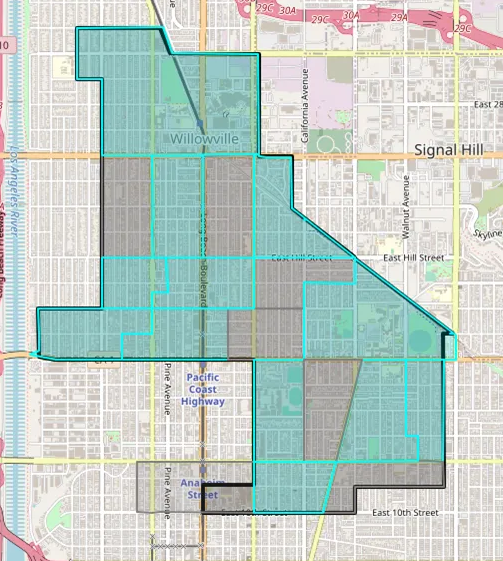
The map shows the Sixth City Council in the city of Long Beach. Light blue voting precincts show where data is available for use whereas gray voting precincts show the absence of voting data.
This map does not show any results of voting - just where voting data is available. Once this data is available, how can we see which precincts voted similarly or differently and how could a politician spend money to try and sway these voting precincs to their point of view?
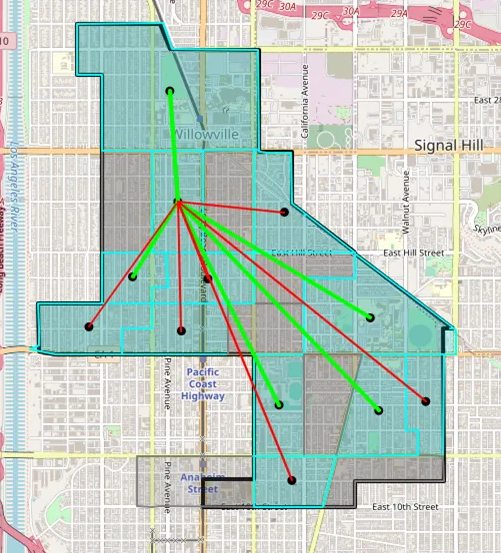
This map shows a graph convolutional network (GCN) superimposed upon the Sixth City Council district. Green lines show stronger connections between voting precincts and red lines show weaker connections between voting precincts.
The strength of connections shows both the similarities in voting trends between two given voting precincts as well as the differences. Both similarities and differences can be exploited in how one targets various precincts to win an election.
A strong green connection would point to areas where a politician would want to "protect their turf" whereas a weak green or weak red connection would be swing voters worth trying to influence. And darker red connections would potentially be "throw away" districts where one is probably going to lose anyway.
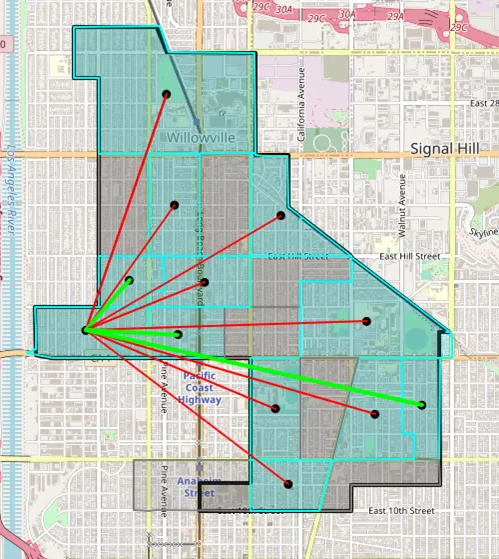
The graph convolutional networks could be built on different issues to show how different voting precincts are most likely to vote on a given issue.
These results could be used to spend money targeting one's likeness with green voting precincts and to spend money pointing out their opponent's position in red districts.
Various strategies can be developed based upon the budget that a politician has available in trying to win his or her election.