The (In)Efficiency of City Services
All of us like to complain about how long it takes to get our streets paved, how long it takes to get a traffic light or stop sign installed, or how long it takes to remove rubbish from known dumping grounds.
LongBeachInnovates focuses on the way ways that the city can deliver various services. We focus on deterministic algorithms that can improve the lives of our citizens when dealing with their local problems.
We utilize known algorithms that learn from past successes, past histories, and have had success in other cities to improve our city.
We review our results to make sure that they make sense.
Come and join us in suggesting to the city ways to provide better services.
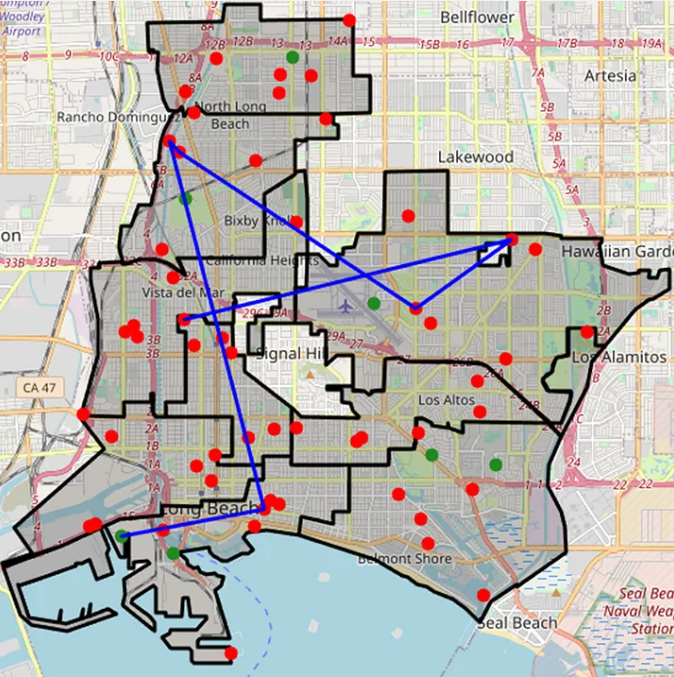
The figure shows a typical city worker in red and the trips that he/she makes to in blue to respond to service requests.
The paths that they travel are restricted to the specific city council districts that they live in.
There has to be a better way.
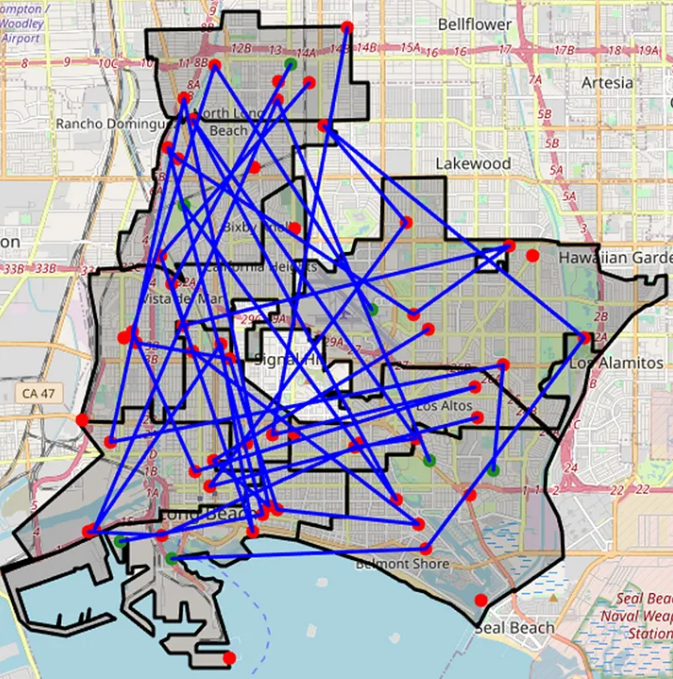
The next figure is much more chaotic.
These paths of service requests were generated using a first-in, first-out assignment to field representatives as they become available after dispositioning their previous assignment.
Things are getting worse.
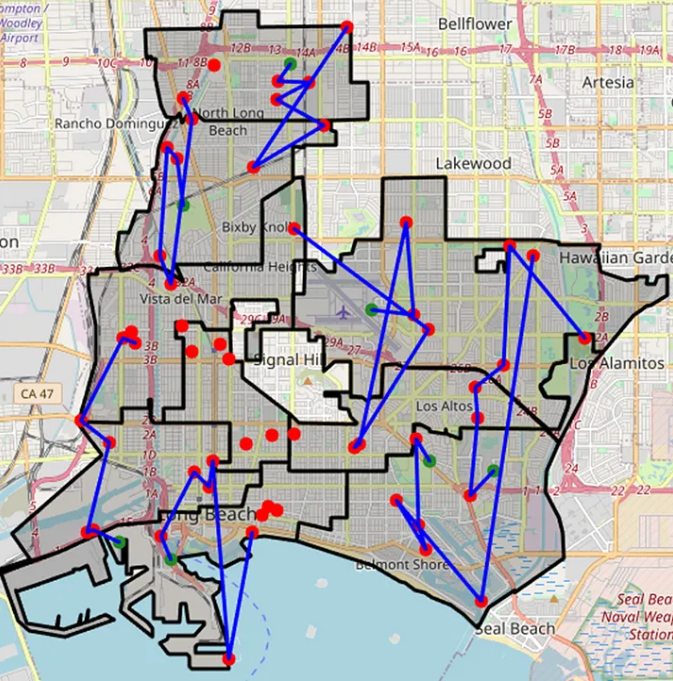
The final map shows were a simple rule that city workers are assigned the appropriate tasks that are closest to their current work location.
In this case, travel time between service calls is greatly reduced, gasoline usage is greatly reduced, and the average savings is approximately a factor of four (for unproductive time in transit and gasoline).
The simplest algorithm can significantly reduce costs and needs no serious AI or other optimization programming costs up-front.